
Maryland: what an unlicensed TC can do
What an unlicensed transaction coordinator may do in Maryland, what needs a license, and why you only type contract forms your licensee directs.
Last reviewed October 2026 from Maryland Real Estate Commission. Maryland contract deadlines →
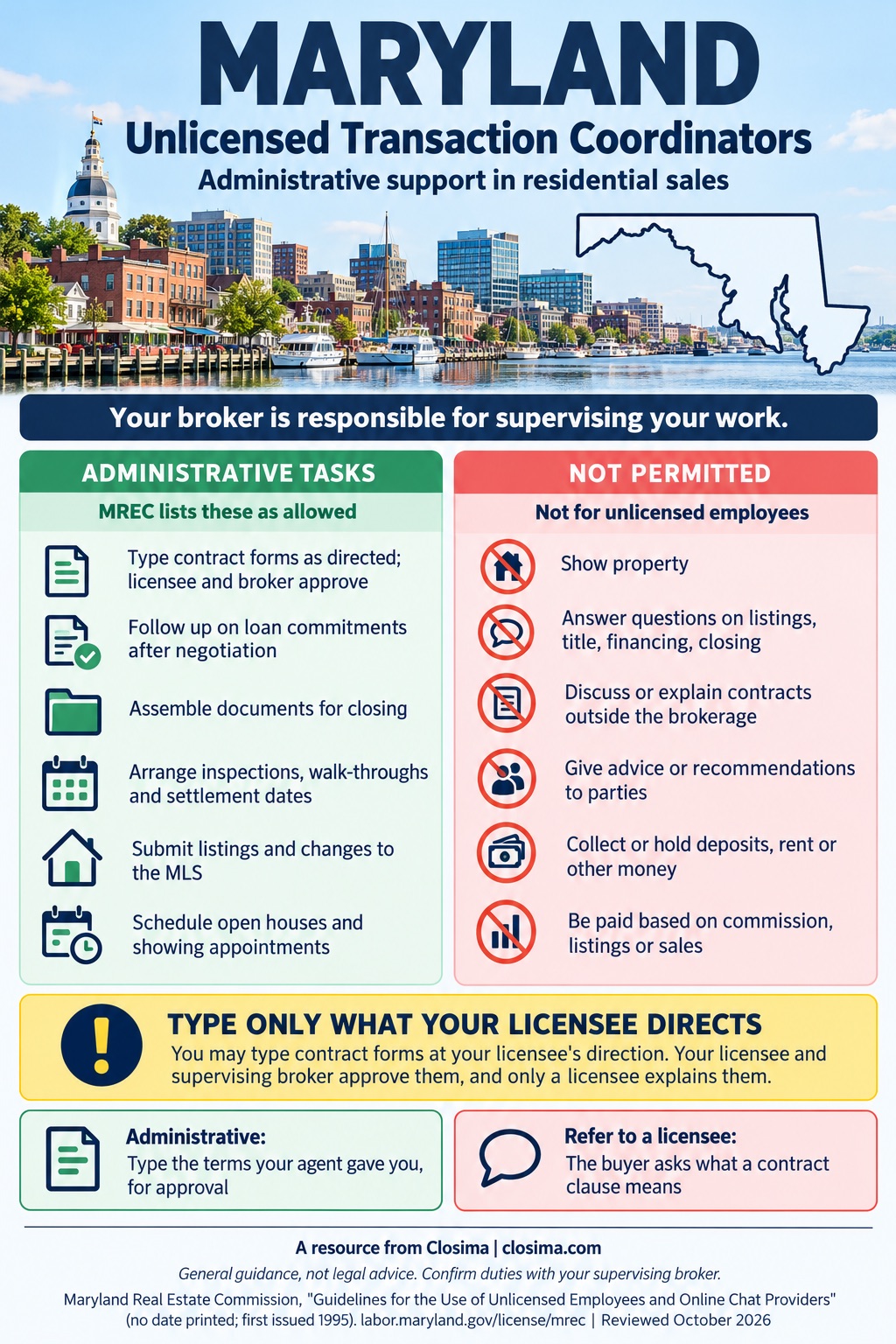
What you can do without a license
Maryland law requires a broker to exercise reasonable and adequate supervision over brokerage services provided on the broker's behalf (Business Occupations and Professions §17-320(c)). MREC says brokers are also responsible for supervising what their employees do in the broker's name during a transaction, whether or not that work needs a license.
You can do (no license needed)
- Answer the telephone and forward calls to a licensee.
- Submit listings and changes to a multiple listing service.
- Type contract forms at the direction of, and for approval by, the licensee and supervising broker.
- Follow up on loan commitments after a contract has been negotiated.
- Assemble documents for closing, and get public documents from the courthouse, utilities and similar offices.
- Arrange the date and time of home, termite and well/septic inspections, the mortgage application, the pre-settlement walk-through and settlement.
- Write ads and prepare flyers for review and approval by the licensee and supervising broker.
- Schedule open houses and showing appointments for a licensee, have keys made, place signs and act as a courier.
Needs a license
- Show property.
- Answer any questions on listings, title, financing, closing and similar matters.
- Discuss or explain a contract, listing, lease, agreement or other real estate document with anyone outside the brokerage.
- Give owners, buyers or tenants advice, recommendations or suggestions about a sale, purchase, exchange or lease.
- Discuss a property's features with a prospective buyer or tenant, or the terms of sale or lease with the owner.
- Collect, receive or hold deposit money, rent or anything else of value from an owner, buyer or tenant.
- Negotiate or agree to any commission, commission split, management fee or referral fee for a licensee.
- Be paid on the basis of real estate activity, such as a percentage of commission or any amount based on listings or sales.
A practical example
- You can:
- Your agent gives you the price, deposit and settlement date. You type them into the contract, and your agent and broker approve it before it goes out.
- Refer to the agent:
- The buyer asks what the financing contingency means. Send the question to your agent.
Staying on the right side of the rules
A license with another broker doesn't count
MREC's guidelines say "licensee" means a licensed associate broker or salesperson affiliated with and supervised by the broker. "An individual who holds a license, but is affiliated with a different broker is considered to be unlicensed for the purposes of these guidelines."
Brokerage policies
When MREC decides whether a broker's supervision is reasonable and adequate, one factor is whether the brokerage has written policies giving clear guidance on the "use and limitations of unlicensed personal assistants" (COMAR 09.11.05.03B(1)(c)(v)). Ask your broker for theirs.
Penalties for unlicensed activity
A person may not provide, attempt to provide, or offer to provide real estate brokerage services without a license (Business Occupations and Professions §17-601). A first offense is a misdemeanor with a fine of up to $5,000, up to one year in prison, or both, and the Commission can impose a penalty of up to $5,000 for a first violation (§17-613).
How Closima handles it
Closima asks whether you hold a Maryland license. If you don't, purchase agreements and addenda go to your agent with a link: they check every value and complete the form, and Closima records that a licensee completed it. If you do, you fill them in yourself and send them to your agent for approval before they go out. Everything else (deadlines, documents, emails, other forms) works as usual. Maryland's guidelines also have your supervising broker approve contract forms, so confirm how your broker wants to sign off; Closima records the licensee's part.
Thinking about a license?
You don't need one to work as a TC in Maryland. A license lets you also do the work in the "Needs a license" column, under a broker. Here's what's involved:
Maryland's first license is a real estate salesperson license. You complete a 60-hour pre-licensing course, including a 3-hour ethics course, with an MREC-approved provider, then pass both the national and state portions of the PSI exam. You also need a commitment from a licensed broker that you will affiliate with them. After you pass, MREC emails your registration number and the steps to apply online. How to apply.
Quick answers
Do you need a license to be a transaction coordinator in Maryland?
No. You can work as a TC in Maryland without a real estate license. Stick to administrative work under a licensed agent and their broker, and leave anything that needs a license to them.
Can an unlicensed TC fill out a purchase agreement in Maryland?
Only as typing. Maryland lets unlicensed employees "type contract forms at the direction of, and for approval by, licensee and supervising broker."
What can an unlicensed TC do in Maryland?
Answer the telephone and forward calls to a licensee; submit listings and changes to a multiple listing service; type contract forms at the direction of, and for approval by, the licensee and supervising broker; follow up on loan commitments after a contract has been negotiated; assemble documents for closing, and get public documents from the courthouse, utilities and similar offices.
What needs a real estate license in Maryland?
Show property; answer any questions on listings, title, financing, closing and similar matters; discuss or explain a contract, listing, lease, agreement or other real estate document with anyone outside the brokerage; give owners, buyers or tenants advice, recommendations or suggestions about a sale, purchase, exchange or lease; discuss a property's features with a prospective buyer or tenant, or the terms of sale or lease with the owner.
How do you get a real estate license in Maryland?
Maryland's first license is a real estate salesperson license. You complete a 60-hour pre-licensing course, including a 3-hour ethics course, with an MREC-approved provider, then pass both the national and state portions of the PSI exam. You also need a commitment from a licensed broker that you will affiliate with them. After you pass, MREC emails your registration number and the steps to apply online.
Resources
- Licensing FAQsHow to apply: the 60-hour pre-licensing course, the PSI exam, then the online application.
- Taking the examThe salesperson exam has a national and a state portion, each passed with at least 70%.
- Approved education providersMREC's list of schools, with pre-licensing providers marked.
- License searchCheck an agent's or brokerage's Maryland license.
- Guidelines for the Use of Unlicensed EmployeesMREC's lists of what unlicensed employees may and may not do.
- Laws and regulationsLinks to the Maryland Real Estate Brokers Act (Business Occupations and Professions, Title 17) and COMAR 09.11.
- Continuing education requirementsSalespersons licensed on or after October 1, 2023 take 15 set hours before their first renewal.
Questions about what's allowed? Ask the regulator: Maryland Real Estate Commission (MREC), 410-230-6200, [email protected].
Source: Maryland Real Estate Commission, "Guidelines for the Use of Unlicensed Employees and Online Chat Providers" (No date printed (guidelines first issued 1995, republished with minor edits)).
Buying or selling a home yourself? These pages are for people who work in real estate. Work with a licensed agent or a real estate attorney.
General information, not legal advice. Rules change, and your broker's policies may be stricter: confirm your duties with your supervising broker and your state's real estate regulator.
See also: Maryland contract deadlines · How to become a transaction coordinator
Run your files with Closima
Deadlines from your state's contract, documents tracked, follow-up emails drafted, and forms filled the right way for your state. Your first 3 transactions are free, with no monthly fee.
Start free →