
Massachusetts: what an unlicensed TC can do
What Massachusetts law says about unlicensed transaction coordinators, which acts need a license, and why contract terms should stay with a licensee.
Last reviewed October 2026 from Massachusetts General Laws. Massachusetts contract deadlines →
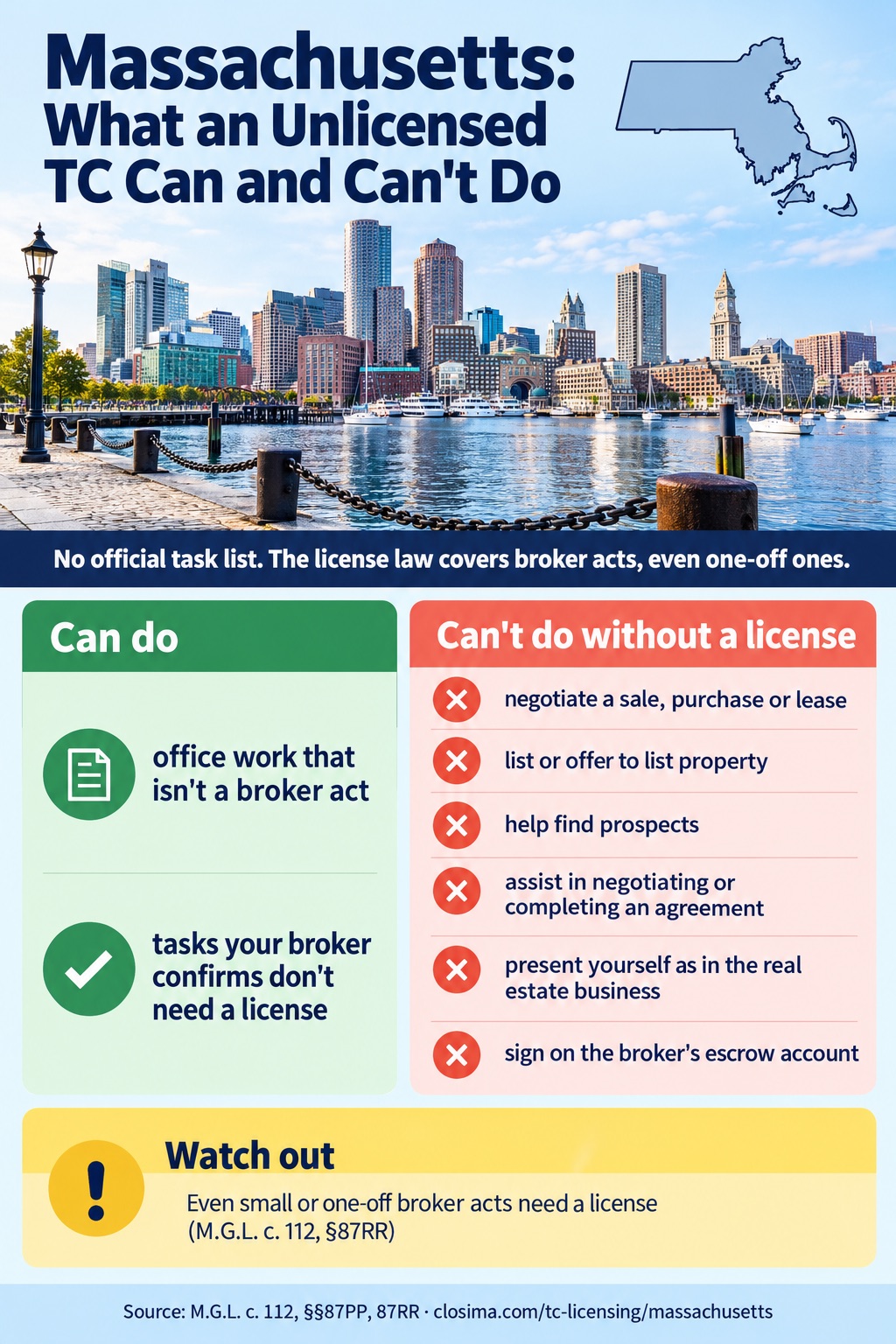
What you can do without a license
Massachusetts law makes a broker responsible for the salespeople who work for them, and the broker must approve the negotiation and completion of their transactions (M.G.L. c. 112, §87RR). The law says nothing specific about unlicensed staff, so confirm your duties with your broker.
You can do (no license needed)
- Do office work that is not one of the broker acts listed in M.G.L. c. 112, §87PP.
- Take on tasks your broker has confirmed don't need a license.
Needs a license
- Negotiate, or offer or attempt to negotiate, a sale, purchase, rental or lease.
- List, or offer or attempt to list, real estate.
- Assist or direct in procuring prospects for a transaction.
- Assist or direct in the negotiation or completion of an agreement or transaction for a sale, purchase or lease.
- Advertise or hold yourself out as engaged in the business of selling, buying or renting real estate.
- Sign on, keep or maintain the broker's escrow account.
A practical example
- You can:
- Keep the file's signed documents organized and tell your agent what is still missing.
- Refer to the agent:
- The buyer's agent calls about a repair credit. Your agent negotiates it.
Staying on the right side of the rules
No official task list
The Board of Registration of Real Estate Brokers and Salespersons has not published a list of tasks unlicensed assistants may do. The line comes from the definition of a broker in M.G.L. c. 112, §87PP, which applies to anyone who does those acts for another person for a fee or other consideration.
Escrow accounts
The Board's policy statement, approved February 27, 2019, says only brokers may keep, maintain and be signatories to escrow accounts. "Salespersons and non-licensees are not allowed to be signatories on escrow accounts."
Penalties
Acting as a broker or salesperson without a license can bring a fine of up to $500 (M.G.L. c. 112, §87CCC). The Board can suspend or revoke a license if a licensee pays or shares commissions or fees with a person who is required to be licensed but isn't (§87AAA(e)).
We asked the Board
On October 16, 2026, we asked the Massachusetts Board of Registration of Real Estate Brokers and Salespersons whether it has guidance on what an unlicensed assistant may do. It replied that it "does not give legal advice or interpretation of the regulations to the public." Until it does, follow the license law above, keep anything that looks like a broker act with your licensee, and confirm your duties with your broker.
How Closima handles it
Closima asks whether you hold a Massachusetts license. If you don't, purchase agreements and addenda go to your agent with a link: they check every value and complete the form, and Closima records that a licensee completed it. If you do, you fill them in yourself and send them to your agent for approval before they go out. Everything else (deadlines, documents, emails, other forms) works as usual.
Thinking about a license?
You don't need one to work as a TC in Massachusetts. A license lets you also do the work in the "Needs a license" column, under a broker. Here's what's involved:
Massachusetts' first license is the real estate salesperson license. You must be at least 18, complete 40 hours of real estate education at a Board-approved school, get three candidate endorsements, and apply through the eLIPSE portal with a DOL CORI form. You then schedule the exam with PSI and need 70% to pass, and PSI issues the license after you pass. A salesperson must be engaged by a licensed broker and can't run their own real estate business. How to apply.
Quick answers
Do you need a license to be a transaction coordinator in Massachusetts?
No. You can work as a TC in Massachusetts without a real estate license. Stick to administrative work under a licensed agent and their broker, and leave anything that needs a license to them.
Can an unlicensed TC fill out a purchase agreement in Massachusetts?
Massachusetts has no official guidance for assistants, and assisting in completing an agreement for a fee is broker activity, so leave it to the licensee.
What can an unlicensed TC do in Massachusetts?
Do office work that is not one of the broker acts listed in M.G.L. c. 112, §87PP; take on tasks your broker has confirmed don't need a license.
What needs a real estate license in Massachusetts?
Negotiate, or offer or attempt to negotiate, a sale, purchase, rental or lease; list, or offer or attempt to list, real estate; assist or direct in procuring prospects for a transaction; assist or direct in the negotiation or completion of an agreement or transaction for a sale, purchase or lease; advertise or hold yourself out as engaged in the business of selling, buying or renting real estate.
How do you get a real estate license in Massachusetts?
Massachusetts' first license is the real estate salesperson license. You must be at least 18, complete 40 hours of real estate education at a Board-approved school, get three candidate endorsements, and apply through the eLIPSE portal with a DOL CORI form. You then schedule the exam with PSI and need 70% to pass, and PSI issues the license after you pass. A salesperson must be engaged by a licensed broker and can't run their own real estate business.
Resources
- Prepare for and schedule your Real Estate license examThe Board's requirements for the salesperson and broker exams, fees and how to apply.
- Renew a real estate licenseSalespersons and brokers need 12 hours of continuing education to renew.
- Check a licenseThe Division of Occupational Licensure's portals for checking a broker's or salesperson's license.
- Board policies and guidelinesBoard policy statements, including who may sign on escrow accounts.
- M.G.L. c. 112, §87PP: definitionsThe definition of a real estate broker and salesman, which sets what needs a license.
- M.G.L. c. 112, §87RR: license requiredNo one may act as a broker or salesman, even incidentally, without a license.
Questions about what's allowed? Ask the regulator: Board of Registration of Real Estate Brokers and Salespersons (Division of Occupational Licensure), 617-701-8661, [email protected].
Source: Massachusetts General Laws, c. 112, §87RR (license required) and §87PP (definitions of broker and salesman) (No revision date printed (read October 15, 2026)).
Buying or selling a home yourself? These pages are for people who work in real estate. Work with a licensed agent or a real estate attorney.
General information, not legal advice. Rules change, and your broker's policies may be stricter: confirm your duties with your supervising broker and your state's real estate regulator.
See also: Massachusetts contract deadlines · TC duties, licensed and unlicensed · How to become a transaction coordinator
Run your files with Closima
Deadlines from your state's contract, documents tracked, follow-up emails drafted, and forms filled the right way for your state. Your first 3 transactions are free, with no monthly fee.
Start free →