
North Carolina: what an unlicensed TC can do
What an unlicensed transaction coordinator may do in North Carolina, what needs a license, and why you can type an offer but not help complete one.
Last reviewed October 2026 from North Carolina Real Estate Commission. North Carolina contract deadlines →
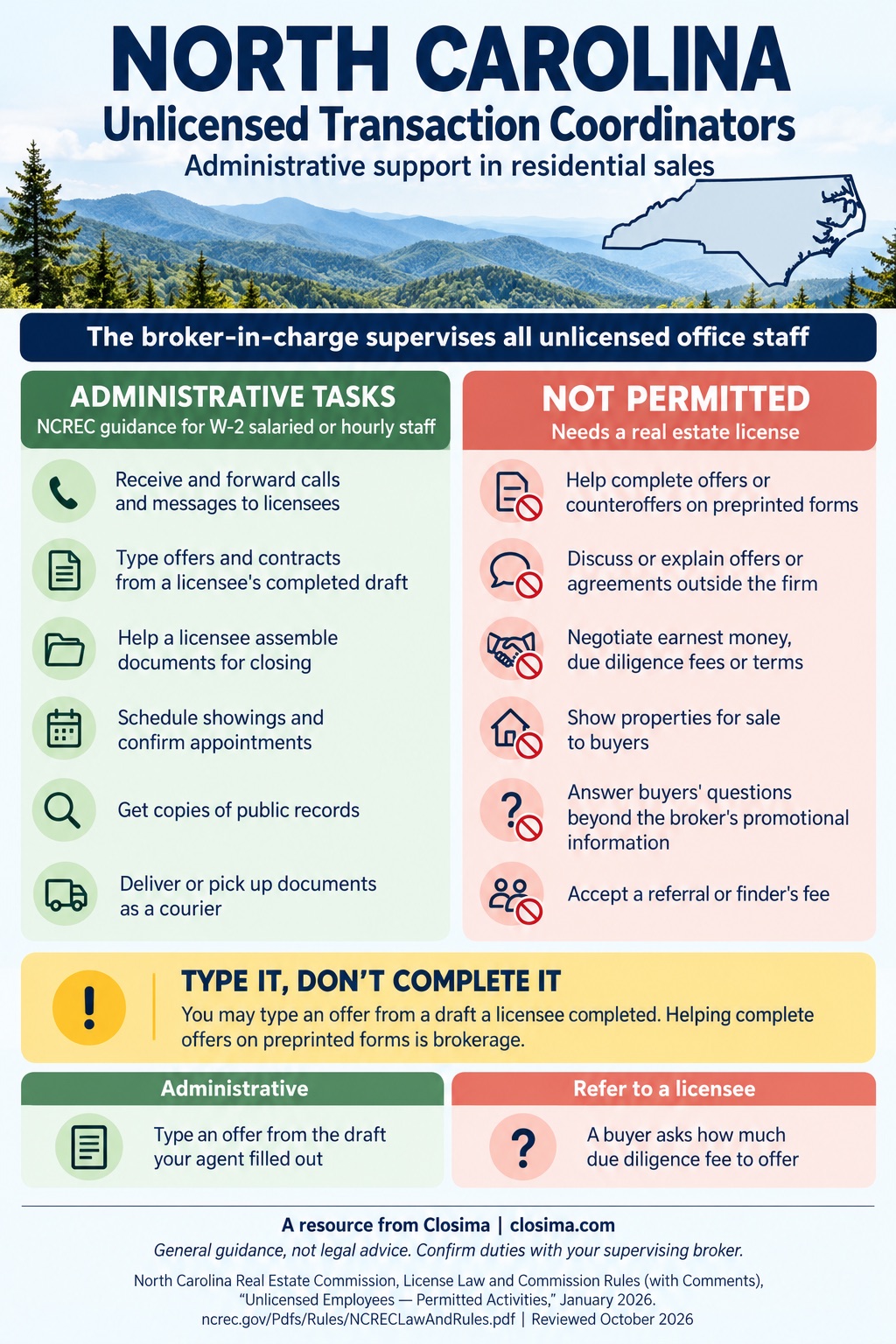
What you can do without a license
Commission rules require the broker-in-charge to supervise all unlicensed individuals employed at the office, and NCREC's guide says the BIC, together with the licensee or team that employs you, is responsible for all your acts.
You can do (no license needed)
- Receive and forward phone calls and electronic messages to licensees.
- Type offers, contracts and leases from drafts of preprinted forms completed by a licensee.
- Help a licensee assemble documents for closing.
- Schedule showing appointments, and coordinate or confirm appointments with licensees, owners, prospects and inspectors.
- Submit listings and changes to the MLS, but only if a licensee compiled and provided the data.
- Get copies of public records from places like the register of deeds or county tax office.
- Act as a courier to deliver or pick up documents.
- Record and deposit earnest money and other trust money under the close supervision of the broker-in-charge.
Needs a license
- Help complete contract offers or counteroffers on preprinted forms.
- Discuss or explain offers, agency agreements, listings, leases or similar matters with anyone outside the firm.
- Negotiate earnest money, due diligence fees or other contract terms.
- Show properties for sale to prospective buyers.
- Answer buyers' questions about listed properties beyond what the broker put in promotional materials.
- Offer opinions about a seller's or landlord's intentions.
- Accept a finder's, referral or similar fee from a licensee.
A practical example
- You can:
- Your agent hands you a completed draft offer, and you type it into the form exactly as drafted.
- Refer to the agent:
- A buyer asks how much due diligence fee to offer, or the seller's agent wants to change the earnest money. Your agent handles it.
Staying on the right side of the rules
How you're paid matters
NCREC's list of allowed tasks applies to an assistant who is "a W-2 salaried or hourly paid and is not paid on a per-transaction basis." Separately, NCREC told a would-be transaction coordinator that checking and organizing paperwork "does not require a real estate license if there is no brokerage taking place and payment is made by a flat fee." Ask your broker-in-charge how your pay is set up.
Penalty for unlicensed activity
G.S. 93A-1 makes it unlawful to act as a real estate broker without a license from the Commission. Under G.S. 93A-8, a person who violates it is guilty of a Class 1 misdemeanor on conviction.
Broker responsibility
Commission Rule 21 NCAC 58A .0110(g)(10) requires the broker-in-charge to "supervise all unlicensed individuals employed at the office". NCREC's guide tells licensees: "Never ask an unlicensed person to perform a licensed activity."
How Closima handles it
Closima asks whether you hold a North Carolina license. If you don't, purchase agreements and addenda go to your agent with a link: they check every value and complete the form, and Closima records that a licensee completed it. If you do, you fill them in yourself and send them to your agent for approval before they go out. Everything else (deadlines, documents, emails, other forms) works as usual.
Thinking about a license?
You don't need one to work as a TC in North Carolina. A license lets you also do the work in the "Needs a license" column, under a broker. Here's what's involved:
North Carolina requires the 75-hour Broker Prelicensing Course, a license application with a criminal record report, and a passing score on the license exam (Pearson). New licensees start as provisional brokers, who must be supervised by a broker-in-charge to be active, and must complete 90 hours of Postlicensing education (three 30-hour courses) within 18 months to keep active-status eligibility. How to apply.
Quick answers
Do you need a license to be a transaction coordinator in North Carolina?
No. You can work as a TC in North Carolina without a real estate license. Stick to administrative work under a licensed agent and their broker, and leave anything that needs a license to them.
Can an unlicensed TC fill out a purchase agreement in North Carolina?
Only as typing from the agent's draft. North Carolina lets staff "type offers, contracts and leases from drafts of preprinted forms completed by a licensee." Helping complete them is brokerage.
What can an unlicensed TC do in North Carolina?
Receive and forward phone calls and electronic messages to licensees; type offers, contracts and leases from drafts of preprinted forms completed by a licensee; help a licensee assemble documents for closing; schedule showing appointments, and coordinate or confirm appointments with licensees, owners, prospects and inspectors; submit listings and changes to the MLS, but only if a licensee compiled and provided the data.
What needs a real estate license in North Carolina?
Help complete contract offers or counteroffers on preprinted forms; discuss or explain offers, agency agreements, listings, leases or similar matters with anyone outside the firm; negotiate earnest money, due diligence fees or other contract terms; show properties for sale to prospective buyers; answer buyers' questions about listed properties beyond what the broker put in promotional materials.
How do you get a real estate license in North Carolina?
North Carolina requires the 75-hour Broker Prelicensing Course, a license application with a criminal record report, and a passing score on the license exam (Pearson). New licensees start as provisional brokers, who must be supervised by a broker-in-charge to be active, and must complete 90 hours of Postlicensing education (three 30-hour courses) within 18 months to keep active-status eligibility.
Resources
- Apply for a broker licenseNCREC's step-by-step licensing process, from the 75-hour course to the exam and character review.
- Real Estate Licensing in North Carolina (April 2026)The application booklet: criminal record report, exam, provisional broker status and Postlicensing.
- Broker license searchSearch NCREC's database of active licensees.
- Unlicensed Assistants – Drawing the LineNCREC's two lists of what unlicensed assistants may do and what only licensed brokers may do.
- License Law and Commission Rules (January 2026)The statute, Commission rules and comments, including the permitted activities for unlicensed employees.
- Broker-in-Charge Best Practices GuideNCREC's guide for BICs, including supervising unlicensed assistants and office policies.
- Continuing education FAQsActive licensees need 8 hours of CE each year: a 4-hour Update course and a 4-hour elective.
Questions about what's allowed? Ask the regulator: North Carolina Real Estate Commission (NCREC), (919) 875-3700, [email protected].
Source: North Carolina Real Estate Commission, North Carolina Real Estate License Law and Commission Rules (including the License Law and Rules Comments), "Unlicensed Employees — Permitted Activities" (January 2026).
Buying or selling a home yourself? These pages are for people who work in real estate. Work with a licensed agent or a real estate attorney.
General information, not legal advice. Rules change, and your broker's policies may be stricter: confirm your duties with your supervising broker and your state's real estate regulator.
See also: North Carolina contract deadlines · How to become a transaction coordinator
Run your files with Closima
Deadlines from your state's contract, documents tracked, follow-up emails drafted, and forms filled the right way for your state. Your first 3 transactions are free, with no monthly fee.
Start free →