
Utah: what an unlicensed TC can do
What an unlicensed transaction coordinator may do in Utah, what needs a license, and why completing contracts stays with the licensee.
Last reviewed October 2026 from Utah Division of Real Estate. Utah contract deadlines →
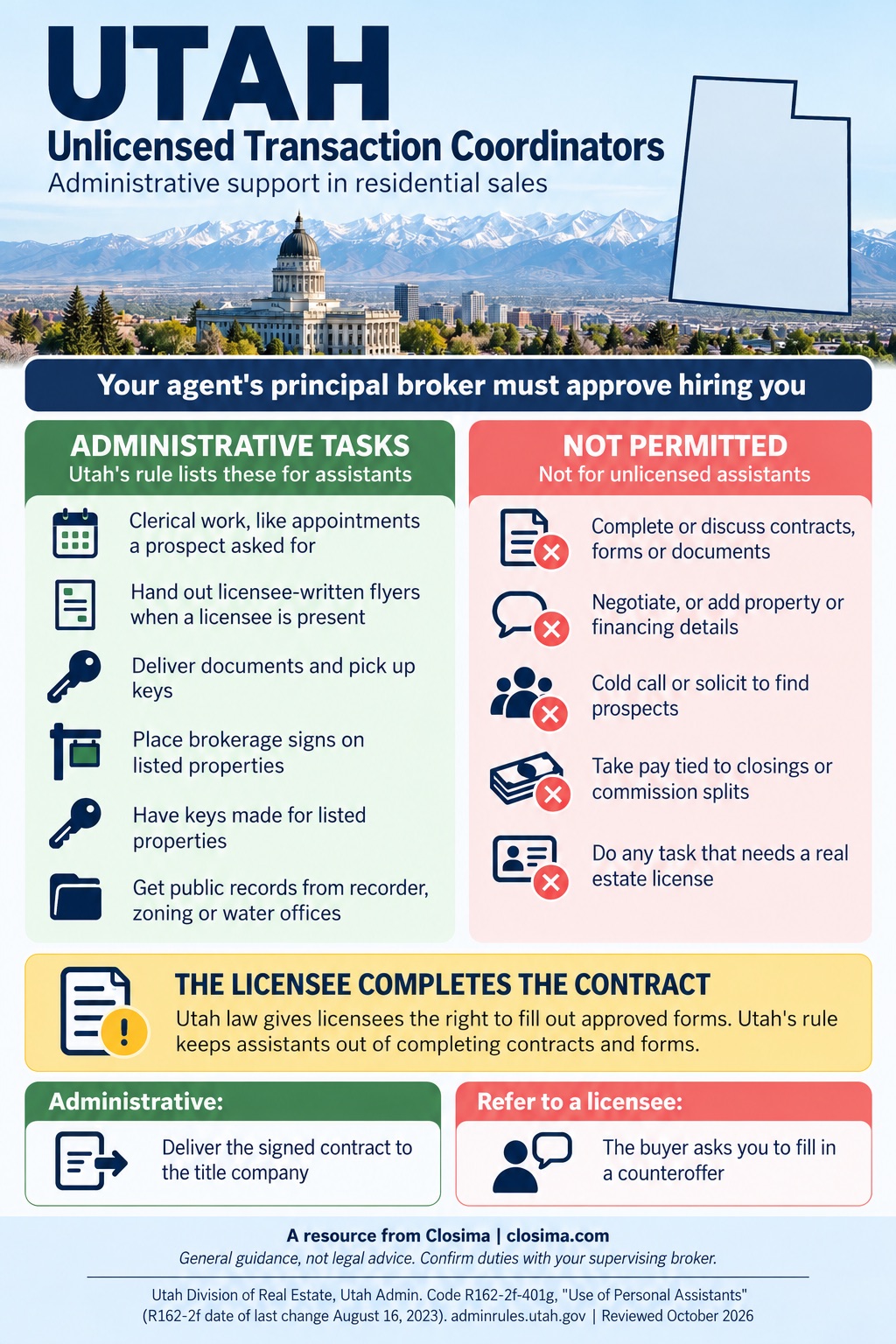
What you can do without a license
The agent who employs you needs their principal broker's permission first and must supervise you. The principal broker must exercise active and reasonable supervision over unlicensed staff.
You can do (no license needed)
- Do clerical work, including making appointments for prospects to meet a licensee, if the prospect started the contact.
- At an open house where a licensee is present, hand out preprinted literature written by a licensee, without adding information about the property or financing.
- Act as a courier: deliver documents, pick up keys and similar errands, without discussing or completing forms or documents.
- Place brokerage signs on listed properties.
- Have keys made for listed properties.
- Get public records from a county recorder's office, zoning office, sewer district, water district or similar office.
- Work for more than one brokerage, doing only tasks that don't need a license and paid at a predetermined rate, such as an hourly salary.
Needs a license
- Complete or discuss forms, documents or contracts.
- Get involved in negotiating, offering or selling, or give extra information about a property or its financing.
- Make telephone solicitations or do anything else meant to secure prospects, other than booking appointments a prospect asked for.
- Be paid an amount that depends on a transaction closing or that comes from commission sharing or fee splitting.
- Do any task that requires a real estate license.
A practical example
- You can:
- Your agent asks you to drop the signed contract at the title company. You deliver them.
- Refer to the agent:
- The buyer asks you to fill in a counteroffer, or to explain a term. Your agent handles it.
Staying on the right side of the rules
Transaction coordinators count as assistants
The Division has written: "An unlicensed transaction coordinator can work for multiple brokerages but can only conduct activities that do not require a license and must be paid at a predetermined rate, such as an hourly salary. The same principles apply to personal assistants. The Division makes no distinction between the two."
Filling out forms is a licensee privilege
Utah Code 61-2f-306 is titled "Rights and privileges of real estate licensees to fill out forms or documents" and says "a real estate licensee may fill out only those legal forms approved by the commission and the attorney general, and those forms provided by statute."
Broker supervision
A principal broker must "exercise active and reasonable supervision over the conduct of each licensee and unlicensed staff" (R162-2f-401c), and failing to supervise licensed or unlicensed staff is grounds for discipline (Utah Code 61-2f-401). The Division has also said it "does not know how a principal broker can adequately and reasonably supervise an individual that is not associated with the principal broker's office."
Penalties
For a violation of the Real Estate Licensing and Practices Act, the Commission can order a civil penalty of up to $5,000 per violation, or the gain from it if greater, and can issue a cease and desist order (Utah Code 61-2f-404). In 2026 a principal broker who used an unlicensed assistant for duties that require a license agreed to a $10,000 penalty and probation, in an order that also covered a separate misrepresentation.
How Closima handles it
Closima asks whether you hold a Utah license. If you don't, purchase agreements and addenda go to your agent with a link: they check every value and complete the form, and Closima records that a licensee completed it. If you do, you fill them in yourself and send them to your agent for approval before they go out. Everything else (deadlines, documents, emails, other forms) works as usual.
Thinking about a license?
You don't need one to work as a TC in Utah. A license lets you also do the work in the "Needs a license" column, under a broker. Here's what's involved:
Utah's first license is the sales agent license. You take 120 hours of approved pre-license education at a certified school, pass the sales agent exam within one year of finishing the course, and apply online within 90 days of passing; fingerprint instructions follow the application. A sales agent must be affiliated with a principal broker, and new agents take a 12-hour New Agent Course before their first renewal. How to apply.
Quick answers
Do you need a license to be a transaction coordinator in Utah?
No. You can work as a TC in Utah without a real estate license. Stick to administrative work under a licensed agent and their broker, and leave anything that needs a license to them.
Can an unlicensed TC fill out a purchase agreement in Utah?
No. Utah's rule keeps assistants out of completing contracts and forms, and state law lets licensees fill out the approved forms.
What can an unlicensed TC do in Utah?
Do clerical work, including making appointments for prospects to meet a licensee, if the prospect started the contact; at an open house where a licensee is present, hand out preprinted literature written by a licensee, without adding information about the property or financing; act as a courier: deliver documents, pick up keys and similar errands, without discussing or completing forms or documents; place brokerage signs on listed properties; have keys made for listed properties.
What needs a real estate license in Utah?
Complete or discuss forms, documents or contracts; get involved in negotiating, offering or selling, or give extra information about a property or its financing; make telephone solicitations or do anything else meant to secure prospects, other than booking appointments a prospect asked for; be paid an amount that depends on a transaction closing or that comes from commission sharing or fee splitting; do any task that requires a real estate license.
How do you get a real estate license in Utah?
Utah's first license is the sales agent license. You take 120 hours of approved pre-license education at a certified school, pass the sales agent exam within one year of finishing the course, and apply online within 90 days of passing; fingerprint instructions follow the application. A sales agent must be affiliated with a principal broker, and new agents take a 12-hour New Agent Course before their first renewal.
Resources
- Sales agent licensingThe Division's steps to become a sales agent: 120 hours of pre-license education, the exam, then the online application.
- Sales agent education and renewalContinuing education: 18 hours each renewal cycle, with at least 9 core hours including the 3-hour mandatory course. New agents take the 12-hour New Agent Course.
- Verify a licenseThe Division's search for checking an agent's or broker's license.
- Real Estate Licensing and Practices Rules (R162-2f)The rules. Section R162-2f-401g lists what unlicensed personal assistants may do.
- Real Estate Licensing and Practices Act (Utah Code 61-2f)The statute, including who must be licensed (61-2f-201) and who may fill out forms (61-2f-306).
- Transaction Coordinators and Personal Assistants (2019 newsletter)The Division's 2nd Quarter 2019 newsletter, pages 18-19, on what unlicensed TCs may do and how they may be paid.
Questions about what's allowed? Ask the regulator: Utah Division of Real Estate (DRE), (801) 530-6747, [email protected].
Source: Utah Division of Real Estate, Utah Admin. Code R162-2f-401g, Use of Personal Assistants (R162-2f date of last change August 16, 2023 (continued February 5, 2025)).
Buying or selling a home yourself? These pages are for people who work in real estate. Work with a licensed agent or a real estate attorney.
General information, not legal advice. Rules change, and your broker's policies may be stricter: confirm your duties with your supervising broker and your state's real estate regulator.
See also: Utah contract deadlines · How to become a transaction coordinator
Run your files with Closima
Deadlines from your state's contract, documents tracked, follow-up emails drafted, and forms filled the right way for your state. Your first 3 transactions are free, with no monthly fee.
Start free →